Showing posts with label Forex. Show all posts
Sunday, May 15, 2011

What are Forex Currency Prices?

Currency is the basic unit used mainly for the exchange of goods and services. There are several different currencies used all around the world. All the countries in the world have their own currencies. There are currencies as strong as US dollar and as weak as Zimbabwean dollar. The value of a currency is necessary for forex trading.
Change in World Economy
Balancing Money and the Earth
[kawashima_umika_05_01-731756.jpg]


Previously the currencies of the world were valued on the basis of their comparison to the price of gold. The price of gold in the international market was a determinant factor in deciding the price of the currency. To maintain the price of their currency states were bound to keep reserves in the form of gold. To make it simple we can say that in the past the more gold reserves a state had the higher the price of its currency would gain.
What Laid the Foundations of Forex

With the passage of time world economy has witnessed many changes. The end of Barton Wood system changed world’s reserve system. The growth of economy required the change in world’s reserve system.

The reserved system which lied previously on gold was replaced with US dollar. Some countries are using Euro as their reserves. However most of the states have a dollar based reserve system.
The Currency Prices

The prices of foreign currencies are referred to as forex or FX in international market. The currency exchange is also known as foreign exchange. These currencies are compared mainly in pairs. The aim is to determine which currency has more value as compare to the other currency. The major pairs are US dollar against the Japanese yen, and/or the British pound against the European euro. US, Britain, Japan, Europe and some other states fall into the category of great economic zones. The currencies of great economic zones are needed worldwide for trade. The Australian dollar, Swiss franc, and Canadian dollar also fall in the category currencies of great economic zones. Hence, the forex currencies of these states are traded in the international banks.
Why Forex is Necessary

What are Forex Currency Prices

The forex is vital for many reasons. The forex currencies are necessary for international trade and commerce. Several banks and other financial institutions trade these currencies for their own benefits.

Not all the currency pairs are as strong as the pair of US dollar and Japanese yen. There weak currency pairs also exist. The pairs of US dollar and Polish zloty and Japanese yen and Thai baht are examples of weak pairs.
Currency Pairs

There is another category of currency pair, which is not used in forex as much as the strong pairs or to some extant the weak pairs. These currency pairs are known as exotic pairs. The currency pairs discussed so far are traded widely. The currencies of rest of the countries are traded for some specific purpose.

Tourists or businessmen, who need these currencies, either get them in exchange of their own currencies or trade them vis-à-vis dollar. In this method of exchange a currency is valued in dollar, and the buyer gets the currency of his need according to its value in dollar.

[kawashima_umika_05_01-731756.jpg]
Wednesday, May 11, 2011

How to Make and Lose a Fortune in Forex?

If you are looking for an online job on internet then you should consider online trading. You can earn a remarkable amount of money by forex trading. When it comes to the fastest, efficient and the most workable online trading then forex trading is the answer. Forex trading offers many benefits for traders if they get enough learning of forex trading before officially starting it. A number of features of forex trading make it is the most suitable tool to generate online money.
Useful Information about Forex Trading Market

When you consider working as a forex trader, you should gather some authentic information about forex trading market to work as an effective forex trader. Following is the useful information for you to get a quick start as a forex trader with full confidence.
Timings of Forex Market

Timings of Forex Market

Forex market remains open 24 hours a day around the world and it starts working from Sunday (afternoon/evening) till the following Friday (afternoon/evening). You can work online from anywhere in the world and become a day trader.
Risk Probability

Forex market is risky for amateur traders, but still if you learn before start working as a forex trader then you can trade effectively with low risk.
Amount of Investment

You can start your forex trading account will a very little amount of investment. This is because the technological advancements that have made it is easier for home based small investors to start online trading with only few hundred dollars.
Forex Pips

Forex market allows you to take a start with little investment and you can easily find brokers regardless of the amount you can invest. A number of brokers are always available to offer you their services.
Price Actions

You should be aware of the changes occur in price. It is obvious that you cannot know about the exact change in price but you can predict these price actions by using any analysis method.

Price actions are the reasons for the continuous working of forex market and without price fluctuations there will be no forex trading.
Currency Market

Currency Market

If you decide to trade in currency market then you can generate profit by the fluctuations occur in price. On the other hand, if you decide to trade in shares and stocks, then you have to rely only on the rising of market.
Dummy Trading Accounts

You can take a start with a dummy forex account. These accounts are being offered by the online forex brokers. You don’t have to invest real money unless you feel sure about your success in forex trading.

It is recommended to you to learn forex trading or take a course of forex trading before starting it officially. After that you should choose a system and try to stick with that system. Be persistent and train yourself to bear the ups and down of forex trading. You also have to learn from your mistake if you want generate real profits. For online trading, it is highly important for you to find an authentic website. Search a reliable forex trading system that you feel is suitable for your personality type and for your lifestyle.
Saturday, May 7, 2011

Mobile Apps for Trading in Currency Markets

Honoka Hot Jepanese Girl


The world is changing too rapidly. When forex trading business was introduced, no one had guessed that it would spread so widely and would soon take over the world. The small and medium investors themselves feared that it would take quite long to gain popularity. However, the popularity in this short span is quite remarkable.
Forex Trading Platform

Forex Trading Platform

The apex of the forex trading came when automated Forex trading platforms were introduced. The markets took a dramatic, gigantic and tremendous turn, making the business the most sought after by investors around the globe.
Technology

As “Necessity is the mother of Invention”, so when the business took a leap, then the necessities also took rise. Thus, technology started playing its part to make the system better and better and this process of introducing new technologies is going on daily purpose.

The reward goes to the technology, which has made the business accessible by one and all from anywhere any time.
Forex and mobile phones

Mobile phones have revolutionized the world so as Forex trading. The trend of doing Forex trade through mobile phones is growing very rapidly nowadays. Investors and the traders find it very comforting to trade via mobile phones. It is because of mobile facility, that the investors and traders can manage their accounts, while on the move from any location on the face of earth.
Jack of all trades

Earlier it was quite harder for the businessmen who were doing different business to do forex trading as side business. The mobile technology has specially provided ease to those businessmen who are doing a bunch of jobs and are facing shortage of time, even though they want to be a part of forex trading. Now they can at the same time continue their business and do active forex trading.
Software

Forex Software

There is mobile trading software through which investors get all the updates on their phones around the clock, including charts and other indicators. An investor through this software can easily control as well as manage his open positions and even execute the pending orders. So, no matter how long the distance is, the investor can still make the right decisions and can do forex trading. The software is meant for those who want to take Forex trading as a part time business and for those who suffer the time problems. The trading software is a little costly and all the investors may not be able to purchase it. However, by looking into the functionalities, it is indeed need of the hour. These software’s have added glamour, color ease and fun to the Forex trading business.

The latest touch-screen models can maximize the ease of operation, making Forex trading such an easy deal just at one’s fingertips.
Friday, May 6, 2011

“Currency Manipulation” Will Continue, Despite G20


Last month, the G20 finally agreed on the specific factors that would be used to determine whether a country was manipulating its currency. Despite being watered-down (by the usual suspects), the so-called “scorecard” is nonetheless extremely substantive. Unfortunately, the resolution will be backed only by “peer pressure,” rather than any kind of real enforcement mechanism, which means that in practice it is basically worthless.


While the proximate goal of the resolution is to eliminate exchange rate manipulation, it’s ultimate goal is to minimize the risk of another economic/financial crisis. Towards that end, a country’s “budget deficit levels, the external imbalance and private savings rates” will be closely scrutinized, and will be warned if any of these factors reach levels that are deemed to be unsustainable. The idea is that an early warning system will prevent the global economy from reaching a point of disequilibrium that is so severe that crisis would be impossible to avert.

Of course, the problems with this program are manifold. First of all, there are no concrete numbers. For example, it’s not clear how large a country’s national debt or trade deficit has to reach before it receives a phone call and slap on the wrist from the G20. In fact, you could argue that the same imbalances that precipitated the crisis are largely still in place, which means that some countries should have been warned yesterday.

Second, there is no meaningful enforcement mechanism. That means that countries that disregard the resolution don’t really have anything to fear, other than the wrath of investors. In other words, if governments and Central Banks know that they can manipulate their exchange rates with impunity, what’s to stop them? Look at Japan: its public debt is the highest in the world. It runs a perennial trade surplus. Its citizens are notorious savers. And yet, when the Yen rose to a record high, which you might expect from such an imbalanced economy, the G7 (in this case) took the unusual step of pushing the Yen down. I’m not saying this wasn’t the right thing to do, but what kind of signal does this send to other rule breakers.

While all emerging market countries took an active interest in exchange rates (and seek to exert some control over their currencies), China is certainly Public Enemy #1, and is the clear target of the “currency manipulation” talk. To its credit, the People’s Bank of China (PBOC) has permitted the Chinese Yuan to appreciate 20% against the Dollar (probably 30% when inflation is taken into account) over the last few years. Meanwhile, both internal government statisticians and the IMF expect its current account surplus to narrow to a mere 5% in 2011, as its economy slowly rebalances.

In this sense, I think China is a case in point that the best enforcement mechanism is reality. Specifically, China has reached a point where it cannot continue to pursue an economic policy based on exports, without spurring inflation and causing the inefficient allocation of domestic capital (such as in real estate). It must raise interest rates and accept the continued appreciation of the RMB is an unavoidable byproduct.

The same goes for other countries that attempt to hold their currencies down. If they can get away with it, then so be it. If not, I can guarantee that it won’t be the G20 that forces them to change.

Does Japan’s “Triple Disaster” Threaten the Dollar?


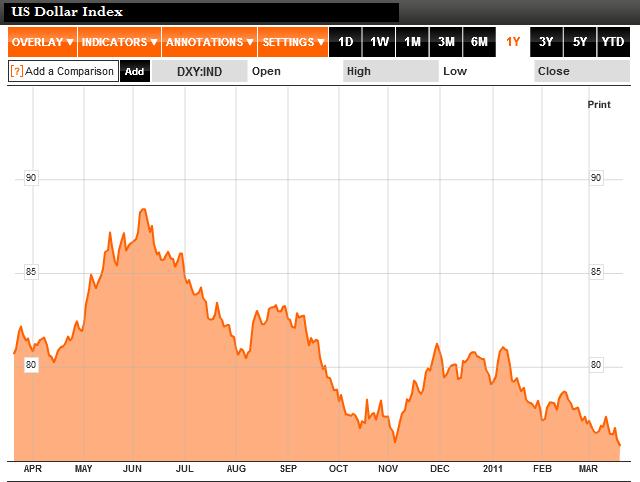
While analysts have been busy dissecting the implications of the natural disasters that ravage(d) Japan for forex markets, the focus has naturally been directed towards the Yen. Given all the rumors about the liquidation of foreign (i.e. Dollar-denominated) assets, it’s also worth examining the potential impact on the Dollar. In a nutshell, Japan’s holdings of US Treasury Securities are extensive, and even a partial unloading could have serious
implications for the world’s de facto reserve currency.
As I explained in my previous post, the Yen rose to a record high (against the Dollar) following the earthquake/tsunami/nuclear crisis because of rumors that Japanese insurance companies and other financial institutions would begin repatriating all of their foreign assets in order to pay for rebuilding. (For the record, it’s worth pointing out again that this has yet to take place, and any repatriation is probably related to the approaching fiscal-year end. Thus, the Yen is being propelled by speculation/short squeeze. Period.)
Indeed, Goldman  Sachs has estimated that the rebuilding effort will probably cost around $200 Billion. A significant portion of this will no doubt be covered by the payout of insurance claims. How insurance companies will make their claims is of course, unknown. However, consider that Japanese insurance companies have insisted that they have ample cash reserves. In addition, Japan has what is perhaps the world’s most solid earthquake reinsurance (basically insurance for insurers) program, which means primary insurance companies can basically pass these claims up the chain, perhaps all the way to the government.
As for whether the Bank of Japan will sell some its $900 Billion in Treasury holdings, this, too appears unlikely. First of all, the Bank of Japan is doing everything in its power to soften the upward pressure on the Yen, which would not be consistent with selling any of its Dollar-assets. Second,  the Financial Times has further argued that they will be especially unlikely to sell US Treasury securities, because they would lose money on (US Dollar) currency depreciation. Besides, any assets that are sold now to pay for rebuilding would probably need to be repurchased later in order to restore balance sheet equilibrium.
While I am on the topic, I want to draw attention to a recent Treasury report that documented the overseas holdings of Treasury securities. The major surprise was China, whose holdings were revised upwards to $1.18 Trillion (from $892 Billion), which means it is well-entrenched as the most important creditor to the US. However, this was offset by a 50% drop in the Bank of England’s holdings, caused perhaps by a change from US debt to British debt.
As I have written in the past, it seems unlikely – for political, economic, and financial – reasons that China will move to pare its Treasury holdings in a significant way. Simply, it has no other viable options for investing the foreign exchange reserves that it is forced to accumulate because of the Yuan-Dollar peg. Other doomsdays have speculated that the crisis in the Middle East will end the “petro-Dollar” phenomenon, whereby oil exporters settle their bills almost exclusively in Dollars and use the proceeds to buy Treasuries. While US influence in the Mid East may indeed wane further as a result of the ongoing political turmoil, I don’t think this will force a change to the PetroDollar phenomenon, which is due as much to unavoidable trade surpluses as it is to settling oil transactions in US Dollars.
There is certainly some concern about what will happen when the Fed wraps up QE2 later this year and stops buying Trreasury securities. Two prominent investment companies (PIMCO and Vanguard) have warned that this will cause bond prices to fall and interest rates on debt to rise rapidly. While this is certainly possible, demand for Treasuries will remain strong for as long as the current risk-averse climate remains in place. In addition, given that the US Treasury is not in danger of defaulting anytime soon, yields reflect expectations for inflation and interest rates more than supply/demand for the bonds themselves. Finally, when the Fed stopped buying mortgage backed securities in 2010, mortgage rates fell, contrary to expectations.
In short, the Dollar might continue to fall against the Yen as speculators cover their short positions, but not because of any fundamental reasons. On an aggregate basis, the never-ending string of crises won’t cause the Dollar to collapse. If anything, it might even bring some risk-averse capital back to the US and re-affirm the Dollar’s status as global reserve currency.
Tuesday, May 3, 2011

How to Trade In 2011?

Kuninaka Ryoko
One of the basic and foremost instincts of a human being is to earn more and more profits. Making a profit greatly depends upon market conditions and general tactics. There are some useful steps which if being followed will help a lot, in understanding  the chemistry of these marketing conditions and to get some consistent profits from forex trading.

Day Traders

Most of us prefer being day traders, and it is the utmost desire and necessity to earn some profit by the end of the day. Being an efficient day trader, for instance, one should have in mind the average daily range for each of major currency pairs. In the last three months, most of the leading pairs have noticed their averages fall quite rapidly as indicated by the Average True Range indicator.
So, if the same trend continues, it leads to smaller and smaller trading range at the end of each day.

Necessary Precautions

As for those who don’t know, by the end of December 2010 the average range of the GBP /USD pair was 135 points at the time of writing. People, who enjoy early morning breakouts, must be cautious about trading early in the morning by taking in consideration of overnight trading points range. Moreover, if the range is between 30 to 60 points and breakout takes place, then there is plenty of room for the price to move strongly in the expected direction. This is the same situation when the trading range was in excess of 200 points, and we were sure about the price heading towards the right destination.

Longer Term Trades

Long term trades are always more reliable than the short term trades. Most of the traders are busy trying to get quick profits. However, it is quite a known fact that trading ranges are quite minor now a day’s for major pairs. Usually most of us are far much better off trading the four hour and daily charts. The overall trend, forex trading system uses the daily chart and the four hour chart for pinpointing entry and exit points.

This has worked marvelously for quite a long time, and there is nothing stopping forex from being more profitable in the upcoming years.

Making Money Is Simple

Making Money Is Simple
The major pairs will always confirm very well to technical analysis on these longer time frames. Overall it is a lot easier and quite efficient way to make money. You simply need to come up with a straight-forward trading system that can detect one or two high probability trading opportunities every week.
The crust of the whole scenario is that let the previous and bygones be left aside, there are still plenty of opportunities to make money from forex trading in 2011. This is true if you enjoy the bounty of trading the longer term charts. However, short term trading can also be fruitful despite the narrow trading ranges. We have to look a bit deep and find the right method, which leads to efficient trading.
 
© Copyright 2010-2011 HOT NANJING All Rights Reserved.
Template Design by Herdiansyah Hamzah | Published by Borneo Templates | Powered by Blogger.com.